
Where to Watch Sunset in Chiang Mai: Viewpoints, Transport & Timing
Updated · Idea Smile Tour, Chiang Mai
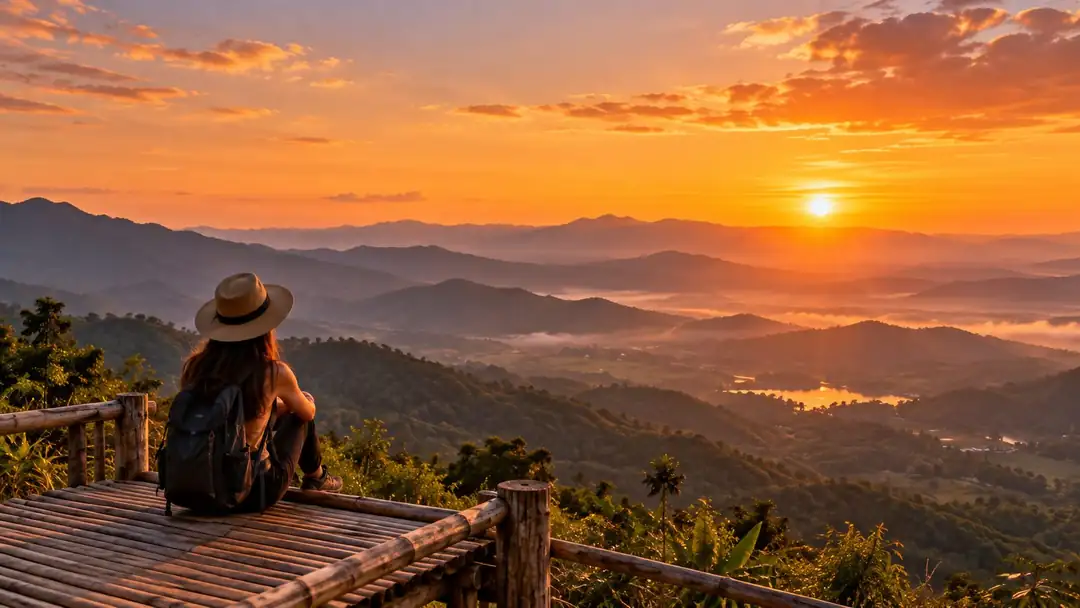
Chiang Mai sits in a valley with the Doi Suthep mountain range on its western side, and that shapes every sunset in the city. From the old town and Nimman the sun drops behind the mountain; to see it go down over the hills, you need to be up on the mountain or out at the edge of the valley. Here are the main options, how to get there and what can spoil the view.
Short answer
For a true mountain sunset, go up into Doi Suthep–Pui National Park; a viewpoint on the mountain looks west over the ranges, and you can see Doi Suthep temple lit up afterwards. For something closer and cheaper, the reservoirs on the city's western edge and rooftop bars give you sunset colours behind the mountain's silhouette. No spot can guarantee a visible sunset: cloud and seasonal haze decide that on the day.
Tours that fit this guide
Idea Smile Tour sells and arranges these tours with local operators (TAT licence 24/01168). Prices are per person from our current tour list; check the tour page for options and the latest details.
Our pick for this guide
Doi Pui Sunset & Doi Suthep by Night
Best for: watching the sunset from the mountain without arranging your own transport down after dark
- Price
- from ฿1,350 per person ≈ US$40
- Duration
- Evening · ~3.5 hrs
- Pickup
- Pickup 16:30–17:00 · back 20:00–20:30
Includes: Transfer, Entrance fees, English-speaking guide, Drinking water and more
See details and book Doi Pui Sunset & Doi Suthep by NightAlso worth a look
Doi Suthep at Night with Wat Pha Lat or Wat Umong
Best for: the temple lit up and the city lights plus a hidden temple, if the sunset itself matters less
- Price
- from ฿650 per person ≈ US$19
- Duration
- Evening · ~4 hrs
- Pickup
- Pickup 16:00–16:30 · back 20:00–20:30
Includes: Transfer, Entrance fees, Travel insurance, English-speaking guide
See details and book Doi Suthep at Night with Wat Pha Lat or Wat Umong
Tell us your date and group size — we'll help you choose. Message us on WhatsAppor browse all tours
First, a note on timing and weather
The sun sets roughly between 5:45 and 6:00 pm around December and close to 7 pm around June. Aim to arrive 30 to 45 minutes early, because the best colours often come just before and after the sun disappears.
The season matters more than the spot. The cool season, roughly November to February, usually has the clearest skies. From around February to April, smoke and haze can turn the sun into a pale disc or hide it completely. In the rainy season, roughly June to October, storms often build in the afternoon, but the evening after a storm can be spectacular. See the best time to visit Chiang Mai for more on the seasons.
Option 1: a viewpoint on Doi Suthep–Pui mountain
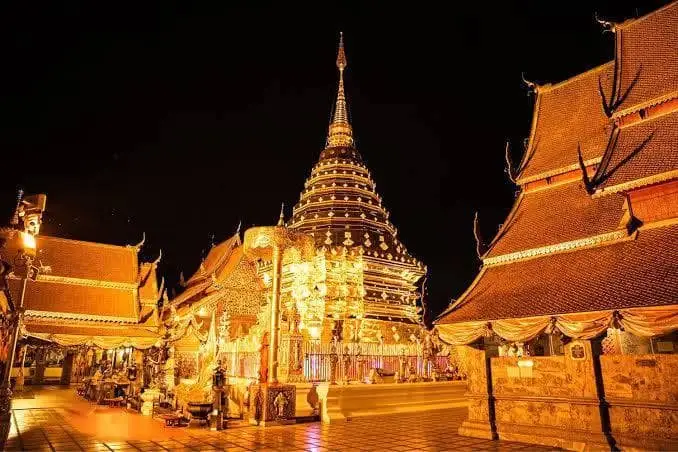
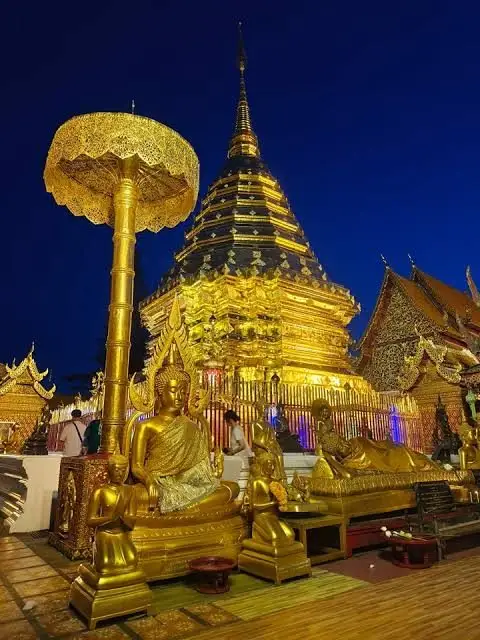
This is the classic choice if you want to see the sun go down over the hills rather than behind them. The road climbs through the national park past Doi Suthep temple and on towards Doi Pui, the higher peak, with viewpoints along the way. The air is cooler and, once the sun has set, you can stop at the temple to see the chedi lit up and the city lights below.
The drawback is transport. The road is steep and winding, and it is dark on the way down. Shared red trucks and ride-hailing apps can get you up, but a ride back after dark is less certain. This is where a guided evening trip helps: the Doi Pui Sunset & Doi Suthep by Night tour picks you up at 16:30–17:00 and drops you back around 20:00–20:30.
Option 2: Huay Tung Tao reservoir
A lake on the north-western edge of the city with the mountains as a backdrop. It is a popular, relaxed place to spend a late afternoon, with simple bamboo huts and places to eat around the water. You see the sky colour over the hills rather than the sun touching a horizon. Most visitors come by scooter, car or ride-hailing app; check whether there is an entry fee and what time the area closes before you go.
Option 3: Ang Kaew reservoir at Chiang Mai University
Inside the Chiang Mai University campus, close to Nimman, this reservoir has a walking path and Doi Suthep rising behind it. It is the easiest of these spots to reach from the city centre and a good choice for a short evening walk. As with Huay Tung Tao, the sun goes down behind the mountain, so expect silhouettes and colour rather than a horizon sunset. Campus access rules can change, so check before you go.
Option 4: a rooftop in Nimman or the old town
Several hotels and bars have rooftops facing west towards Doi Suthep. You don't need transport, you can have a drink or dinner, and you can see the mountain darken as the city lights come on. The trade-off is the view: buildings and the mountain itself block the sun before it reaches the horizon.
The options side by side
| Mountain viewpoint | Reservoirs | Rooftops | |
|---|---|---|---|
| What you see | Sun going down over the western ranges, then the temple lit up | Sky colours behind the mountain, water in the foreground | Mountain silhouette and city lights |
| Getting there | Steep mountain road; plan your ride back | Short ride from the city; scooter or ride-hailing | Walk or short ride |
| Best for | A proper sunset and a night view in one evening | A relaxed, inexpensive late afternoon | Drinks or dinner with a view |
| Watch out for | Cloud on the mountain, dark roads | Closing times and entry rules | No true horizon |
When a guided evening trip makes sense
If you don't ride a scooter, are travelling with older family members, or simply don't want to negotiate a ride down the mountain after dark, a guided trip removes the logistics. It also combines the sunset with the temple at night, which is hard to time on your own. If you only care about the temple lights, Doi Suthep at Night with Wat Pha Lat or Wat Umong skips the sunset viewpoint, adds a quiet hidden temple and costs from ฿650 (≈ US$19). More detail on the temple itself is in our guide Can you visit Doi Suthep at night?.
Frequently asked questions
Where is the best place to watch sunset in Chiang Mai?
For the sun going down over the hills, a viewpoint on Doi Suthep–Pui mountain. For something close to the city, the reservoirs on the western edge or a west-facing rooftop. No spot can guarantee a sunset if it is cloudy or hazy.
Can you see the sunset from Doi Suthep temple?
The temple is better known for its view of the city lights after dark. For the sunset itself, evening tours use a viewpoint higher up the mountain and then visit the temple once it is lit.
What months have the clearest sunsets in Chiang Mai?
Usually the cool season, roughly November to February. Haze from around February to April can hide the sun.
Do I need a tour to watch the sunset on the mountain?
No, but you need a plan for getting back down after dark. A tour such as Doi Pui Sunset & Doi Suthep by Night includes hotel pickup at 16:30–17:00 and drop-off around 20:00–20:30.